
Accelerating Digital Transformation Empowering Your business.
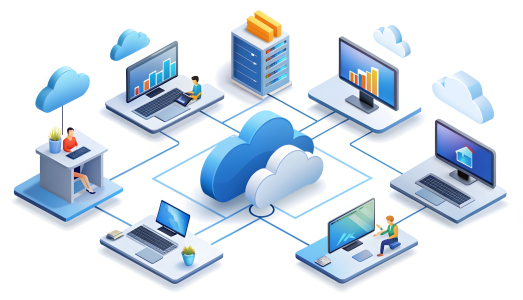
Truetech Cloud Services & Expertise spans across major cloud platforms, including AWS, Azure, and Google Cloud (GCP), enabling us to provide comprehensive cloud migration services tailored to meet the unique needs of our clients. At Truetech, we excel in designing and implementing robust cloud infrastructures that drive efficiency, scalability, and innovation. Our automated deployment solutions streamline processes, reduce time to market, and ensure seamless integration across environments. Our Site Reliability Engineering (SRE) practices focus on enhancing system reliability, optimizing performance, and ensuring the smooth operation of mission-critical applications.
We pride ourselves on our ability to design cloud architectures that not only meet but exceed industry standards for security, compliance, and scalability. Our cloud cost optimization strategies ensure that our clients achieve maximum ROI from their cloud investments, minimizing overheads while maintaining peak performance.
High availability and disaster recovery are cornerstones of our service offerings, ensuring that our clients’ systems remain resilient and operational, even in the face of unexpected challenges. Our comprehensive approach to IT services, enriched by our extensive experience and commitment to excellence, makes Truetech a trusted partner in the digital transformation journey of our clients.
Whether it’s application development, cloud migration, infrastructure management, or IT consulting, Truetech is dedicated to delivering results that empower businesses to achieve their goals with confidence and agility.
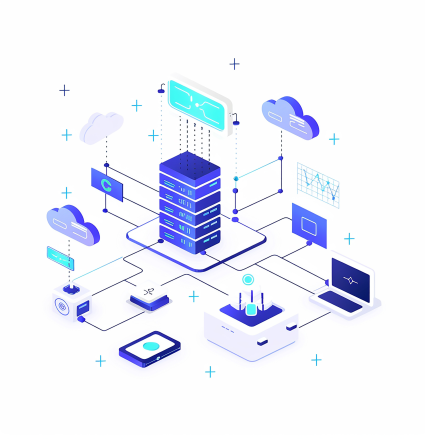
Cloud Operations (Cloud Ops) focuses on the management and operation of cloud environments to ensure optimal performance, reliability, and scalability. Key responsibilities include:

Automating the deployment of cloud resources using Infrastructure as Code (IaC) tools like Terraform, AWS CloudFormation, and Azure Resource Manager (ARM) templates.

Monitoring and managing the utilization of cloud resources to optimize costs, including the use of services like AWS Cost Explorer, Azure Cost Management, and GCP Billing.

Implementing auto-scaling solutions to handle varying loads, ensuring that resources scale up during peak demand and down during low demand to optimize cost.

Establishing backup policies and recovery plans using cloud-native solutions like AWS Backup, Azure Backup, and Google Cloud Backup.

Implementing governance frameworks to ensure compliance with organizational policies and standards, using tools like Azure Policy, AWS Config, and GCP Organization Policies.

SecOps combines security practices with operations to protect cloud environments from threats while maintaining agility. Key areas include
Implementing robust IAM policies to manage user access, including multi-factor authentication (MFA) and least privilege principles using tools like AWS IAM, Azure Active Directory, and Google Identity.
Configuring virtual private networks (VPNs), network security groups (NSGs), and firewall rules to protect cloud networks from unauthorized access and attacks.
Using encryption both in transit and at rest to protect sensitive data, and implementing data loss prevention (DLP) strategies.
Using Security Information and Event Management (SIEM) tools like Azure Sentinel, AWS Security Hub, and Splunk to monitor for suspicious activities and respond to security incidents.
Ensuring cloud environments adhere to industry standards and regulations, such as SOC2, ISO 27001, HIPAA, and GDPR, through continuous compliance monitoring and reporting.
DevOps focuses on the automation of software delivery processes, ensuring faster and more reliable releases. Key practices include:
Automating the integration of code changes from multiple contributors into a single software project, using tools like Jenkins, GitHub Actions, and Azure Pipelines.
Automating the release of software to production environments, ensuring that code changes are released quickly and safely. CD tools include Jenkins, GitLab CI/CD, and AWS CodePipeline.
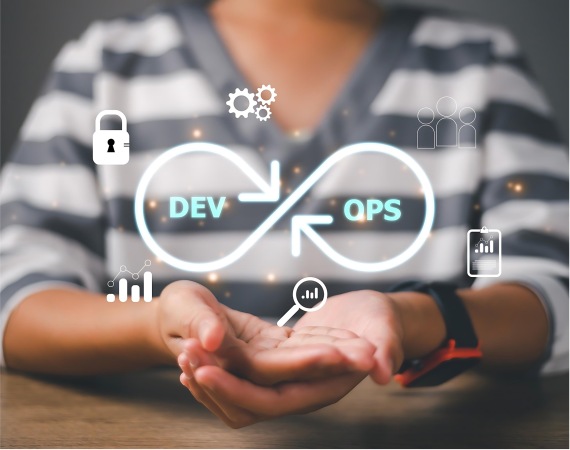
Managing and provisioning computing infrastructure through code rather than through manual processes, using Terraform, Ansible, and Chef.
Incorporating unit tests, integration tests, and end-to-end tests into the CI/CD pipeline to catch issues early. Tools like Selenium, JUnit, and NUnit are commonly used.
Coordinating the deployment of new features and fixes, managing versioning, and automating rollback mechanisms in case of failures.

MonitoringOps focuses on the continuous observation and analysis of applications, infrastructure, and security to ensure optimal performance and security. Key areas include:
Tracking application performance and user behavior using tools like New Relic, AppDynamics, and Dynatrace to identify and resolve issues quickly.
Monitoring the health and performance of infrastructure components, including servers, databases, and networks, using tools like Prometheus, Nagios, and Datadog.
Continuously monitoring for security threats and vulnerabilities using SIEM solutions like Splunk, Azure Sentinel, and AWS CloudWatch.
Collecting and analyzing logs from various systems to gain insights into performance, detect anomalies, and support troubleshooting. Tools include ELK Stack (Elasticsearch, Logstash, Kibana), Fluentd, and Graylog.
Setting up automated alerts for performance degradation, outages, and security incidents, and defining incident response playbooks.

SRE focuses on maintaining the reliability and uptime of software systems while ensuring they can handle high-scale workloads. Key practices include:

Defining measurable objectives for service performance and reliability, such as response time and uptime targets.

Establishing a balance between releasing new features and maintaining reliability by setting acceptable error thresholds.

Developing and executing incident response plans to quickly resolve service disruptions, with tools like PagerDuty and VictorOps.

Proactively testing system resilience by introducing controlled failures to identify weaknesses before they cause outages. Tools like Gremlin and Chaos Monkey are used.

Automating routine operational tasks to reduce human error and improve efficiency, using scripting and automation tools like Ansible and Python.
Migration services involve moving workloads, applications, and data to new environments, often to the cloud, with minimal disruption. Key considerations include:
Evaluating the current environment, identifying dependencies, and planning the migration strategy, including choosing between lift-and-shift, refactoring, or re-platforming.
Using cloud-native migration services like AWS Migration Hub, Azure Migrate, and Google Cloud Migrate, as well as third-party tools like CloudEndure and Carbonite.
Ensuring data integrity and minimizing downtime during migration using strategies like database replication, bulk data transfer, and delta data sync.
Refactoring applications to take advantage of cloud-native services, such as moving from monolithic architectures to microservices.
Testing and validating migrated applications and data to ensure they function correctly in the new environment.
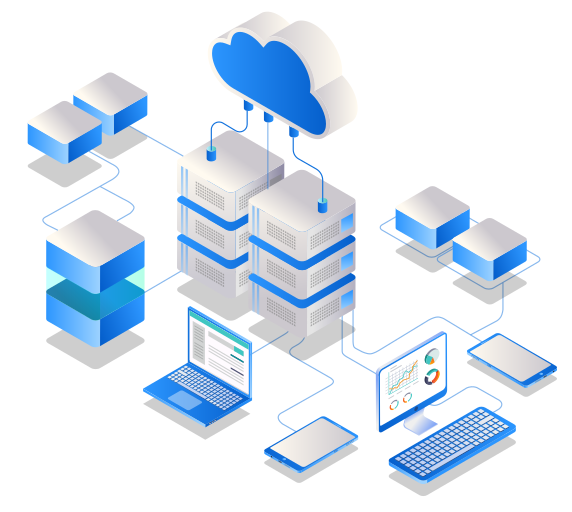
Automation focuses on streamlining and improving efficiency by automating repetitive tasks across various domains. Key automation areas include:

Automating business and IT processes using Robotic Process Automation (RPA) tools like UiPath, Automation Anywhere, and Blue Prism.

Automating application deployment, scaling, and management using container orchestration platforms like Kubernetes and Docker Swarm.

Automating incident detection, response, and resolution workflows to reduce Mean Time to Resolution (MTTR) using tools like ServiceNow, OpsGenie, and PagerDuty.

Implementing chatbots and AI-powered support systems to handle common support queries, reduce manual intervention, and improve customer experience.
Security audits are conducted to ensure that an organization’s systems and processes comply with regulatory standards and best practices. Key areas include:
Ensuring that systems handling protected health information (PHI) comply with HIPAA regulations, focusing on data privacy, security measures, and breach notification requirements.
Implementing tools and processes for continuous monitoring and reporting on compliance status, using platforms like Qualys, Tenable, and Rapid7.

Auditing controls related to security, availability, processing integrity, confidentiality, and privacy. SOC2 audits focus on internal controls and are often required for service providers handling customer data.
Ensuring compliance with ISO 27001 standards, which provide a framework for managing information security risks through a structured Information Security Management System (ISMS).
Auditing data handling practices to ensure compliance with the General Data Protection Regulation (GDPR), including data protection impact assessments, data subject rights, and cross-border data transfers.