
Accelerating Digital Transformation Empowering Your business.

To develop a bespoke application using software development that differentiates your brand and gives you a competitive edge, we need a clear understanding of your business goals, target audience, and technical requirements.
Cloud-native development is a way of building applications to use cloud environments. A cloud-native application consists of discrete, reusable components that are known as microservices that are designed to integrate into any cloud environment. These microservices act as building blocks and are often packaged in containers. Because of this architecture, cloud-native applications can use cloud environments to improve application performance, flexibility, and extensibility.
Just as IT organizations look to the cloud to improve resource management and cut costs, so do software development organizations. In this way, the cloud can be used as a fast, flexible, and cost-efficient integrated development environment (IDE) or development Platform as a Service (PaaS). Cloud-based development environments can support coding, design, integration, testing, and other development functions. They can also offer access to APIs, microservices, DevOps and other development tools, services and expertise
Blockchain is a secure, digitally linked ledger that eliminates cost and vulnerability that is introduced by parties like banks, regulatory bodies and other intermediaries. It is transforming businesses by freeing capital, accelerating processes, lowering transaction costs and more. Blockchain presents a tremendous opportunity for software development. Developers are working with distributed ledgers and open source Hyperledger (link resides outside ibm.com) technology to change how businesses operate.
A key capability for software developers is creating mobile apps with deep connections to data that enriches and elevates user experiences. Forrester has found that “deeply integrating digital/mobile customer data has a strong effect on how customers interact with brands.”
In MBSE, software modeling languages are used to perform early prototyping, simulation, and analysis of software designs for early validation. Building designs in MBSE helps you to analyze and elaborate project requirements and move rapidly from design to implementation
Forrester defines low code as: “Products and/or cloud services for application development that employ visual, declarative techniques instead of programming and are available to customers at low- or no-cost in money and training ...” 4 In short, it’s a development practice that reduces the need for coding and enables noncoders or citizen developers to build or help build applications quickly and at lower cost.
Choosing a software development offering is crucial for the success of any project. It's essential to consider the project requirements, team capabilities, and business objectives to pick the right approach.
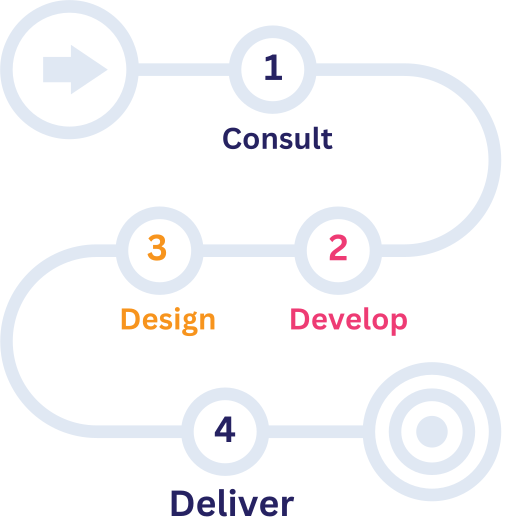
Effective project management is critical to the success of any initiative, ensuring that projects are completed on time, within scope, and within budget while delivering the desired quality. Below are key principles, strategies, and best practices for managing projects effectively.

Effective communication is essential for the success of any software project. It ensures that all team members, stakeholders, and clients are aligned, enabling better collaboration, faster problem-solving, and a smoother development process. In software projects, where teams may be cross-functional and distributed, strong communication helps avoid scope creep, and delays.