

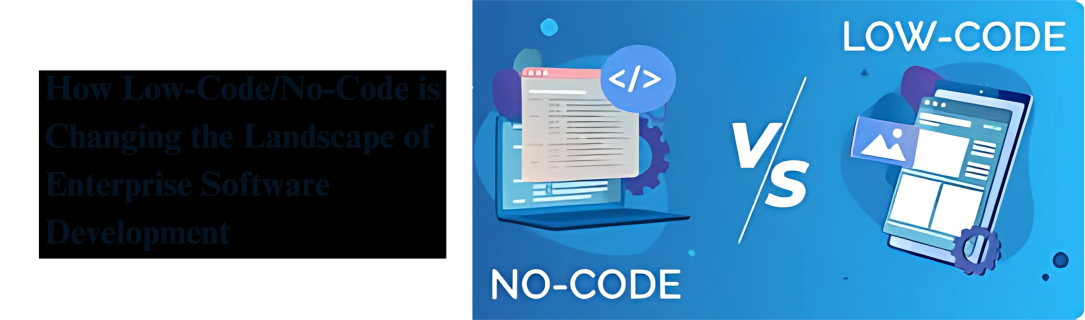
The world of enterprise software development has long been a complicated and costly affair, requiring extensive coding expertise, teams of developers, and significant financial investments. However, with the emergence of low-code/no-code platforms, the landscape of software development is rapidly changing. Low-code/no-code platforms offer a new way to develop software, allowing even those without extensive coding experience to build applications. In this blog post, we will explore how low-code/no-code is changing the landscape of enterprise software development, the benefits it offers, and the challenges it presents.
The Problem: Traditional Enterprise Software Development
AI and machine learning are two emerging technologies that have revolutionized businesses. AI enables machines to think and act like humans, while ML is a subset of AI that allows machines to learn from data and take decisions independently. These two technologies greatly enhance the capabilities of hyper-automation by providing the ability to automate tasks more accurately and efficiently.
The Solution: Low-Code/No-Code Platforms
Low-code/no-code platforms offer a solution to many of the challenges faced by traditional enterprise software development. These platforms allow non-technical users to create applications without the need for extensive coding knowledge or a large team of developers. Low-code/no-code platforms enable businesses to build and deploy software solutions more quickly and efficiently, which can save time and resources.

Benefits of Low-Code/No-Code Platforms
Increased Speed and Efficiency
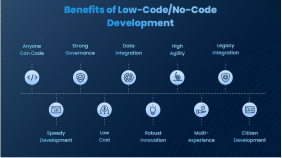
Low-code/no-code platforms enable businesses to rapidly develop and deploy software solutions, drastically reducing the time it takes to go from concept to production. This increased speed and efficiency can help businesses stay ahead of their competition and remain agile in the face of ever-changing market conditions. Low-code/no-code platforms provide a unified platform for development, which makes it easier for teams to collaborate across multiple projects without switching between tools or learning different coding languages.
Reduced Cost
The cost savings associated with low code/no code platforms are significant. Lower total cost of ownership (TCO) means businesses can reduce upfront investments while still delivering quality applications quickly and efficiently. Additionally, low code/no code platforms often include cloud deployment capabilities, which can help reduce infrastructure costs. Furthermore, low-code/no-code platforms allow businesses to quickly test ideas and get feedback from users in a cost effective way, allowing them to iterate quickly on their products.
Increased Innovation
Low-code/no-code platforms offer the opportunity to innovate faster and more effectively than ever before. By providing an environment where non-technical users can build applications, low-code/no-code gives developers the freedom to focus on creating innovative solutions rather than dealing with complex coding issues. Additionally, these platforms provide access to powerful tools that enable teams to quickly deploy new features and updates, making it easier for businesses to stay ahead of the competition, but they can also introduce potential security risks if not properly managed.
Greater Flexibility
Low-code/no-code platforms offer businesses greater flexibility in terms of how they develop, deploy, and manage their applications. This flexibility enables developers to quickly adapt to changing customer needs or try out new ideas without the need for extensive reworking of existing code. Additionally, low-code/no-code platforms allow teams to easily scale up or down their development efforts as needed, ensuring that resources are used efficiently.
Increased Security
Low-code/no-code platforms can offer increased security due to the fact that they are built using secure, reliable frameworks. Additionally, low-code/no-code platforms often provide access control and user authentication capabilities that help ensure applications are only accessible by authorized users. Finally, many of these platforms also include audit logging capabilities that can be used to track user activity and detect potential security issues.
Case Study: Unilever
Unilever, a multinational consumer goods company, is an example of a business that has successfully implemented low-code/no-code platforms. Unilever used a low-code platform to build an application that automates its promotional forecasting process. The application reduced the time required to forecast promotions from 8 hours to just 5 minutes. This not only saved time and resources but also improved the accuracy of the forecasting process.

Challenges of Low-Code/No-Code Platforms
While low-code/no-code platforms offer many benefits, they also present some challenges.
Limited Customization
One challenge associated with low-code/no code platforms is the limited ability to customize applications. Low-code/no-code platforms provide pre-built components that can be used to quickly build applications, but they are limited in terms of how much customization is possible. Additionally, the pre-built components may not always meet the exact needs of a given business and may require additional coding or development work to make them suitable for that organization’s specific requirements.
Integration with Legacy Systems
Low-code/no-code platforms may not be compatible with legacy systems, making it difficult to integrate them into existing IT infrastructures. This can be a challenge for businesses that have already invested heavily in legacy systems.
Professional Services
The implementation of low-code/no-code platforms can be time consuming and require technical expertise to ensure a successful deployment. As such, businesses may need to invest in professional services to ensure that the platform is properly configured and all necessary elements are included.
Conclusion
Low-code/no-code platforms are changing the landscape of enterprise software development, offering businesses a new way to develop and deploy software solutions. These platforms offer many benefits, including increased speed and efficiency, greater flexibility, empowerment of non-technical users, and lower costs. However, they also present some challenges, including limited customization, integration with legacy systems, and a skillset gap.
As low-code/no-code platforms continue to evolve and become more sophisticated, we can expect to see even more businesses embracing this technology. For businesses looking to stay ahead of the curve, adopting low-code/no-code platforms can be a game-changer, allowing them to quickly and efficiently develop software solutions that meet their unique needs.